
The PPWR Is Coming: What It Means for Your Packaging
5 minute read — Sustainability, Industry News
If you export goods into Europe, there’s a big piece of legislation heading your way: the Packaging and Packaging Waste Regulation (PPWR). It applies across all 27 EU member states from 12 August 2026, and it touches every layer of your packaging — not just the box your customer opens.
At Actionpoint, we believe in educating, not telling. So here’s our plain-English guide to what the PPWR actually says, who it affects, and what you can start doing about it now.
What Is the PPWR?
The PPWR (Regulation (EU) 2025/40) replaces the 30-year-old Packaging Directive. The key difference is in the name: it’s a Regulation, not a Directive. That means it applies identically and directly in every EU country — no more 27 different national versions of the same rules. One standard, right across the bloc.
Who Needs to Care?
Pretty much anyone selling into Europe. There’s no exemption for smaller businesses, and the rules reach non-EU exporters too — including sales made through online marketplaces. If your goods cross into the EU in any kind of packaging, this legislation is relevant to you.
What’s Actually Changing
We work with packaging every day, so here’s how we’d summarise the headline changes for our customers:
Less packaging, less empty space. Weight, volume, and empty space must be cut to the functional minimum. For e-commerce shipments specifically, empty space can’t exceed 40% of the box from August 2026. Oversized boxes with a fistful of air pillows won’t cut it any more.
A recyclability grading system. Packaging will be graded A to E for recyclability, and from 2030 only Grade C or above will be allowed on the EU market. It’s worth reviewing your materials and construction now, well ahead of that deadline.
Minimum recycled content for plastics. Plastic packaging will need a minimum share of recycled, post-consumer material, with the required percentage increasing through 2030 and 2040.
Reuse and refill obligations. Reuse systems must be in place for certain packaging formats from August 2026, with binding reuse targets for transport, sales, and e-commerce packaging following from 2030. Some takeaway food and drink packaging will also need refill options.
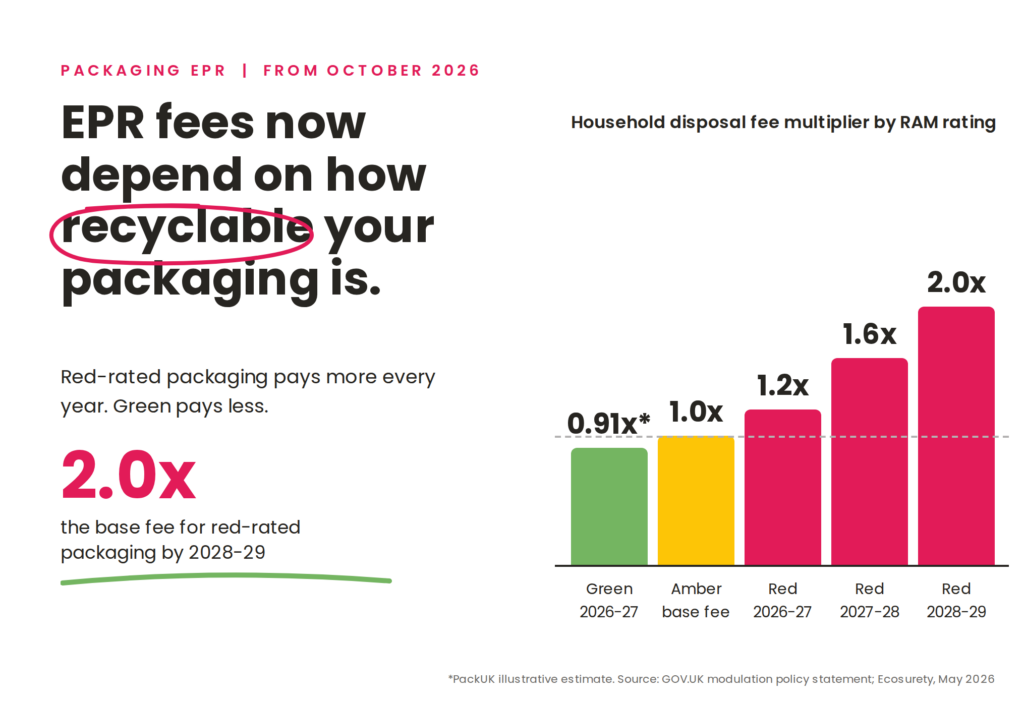
Extended Producer Responsibility (EPR). Producers carry financial responsibility for their packaging’s whole life cycle — collection, sorting, recycling, disposal. Fees are scaled by recyclability, recycled content, reusability, and any substances of concern. In short: better design means lower fees, exactly as it does under the UK’s own EPR scheme.
Clearer labelling. Consumers should be able to tell what packaging is made from, where it goes for disposal, and how to return it for reuse — with consistent symbols and colours across the EU.
Restrictions on substances of concern. From 12 August 2026, food packaging containing PFAS above set limits can no longer be placed on the EU market.
Why This Matters So Much Right Now
Roughly 40% of all plastics used in the EU go into packaging, and the average European generates around 190 kg of packaging waste a year. Member states are required to cut that per-capita figure by at least 5% by 2030, 10% by 2035, and 15% by 2040. The PPWR is the mechanism for getting there — and it applies to every layer of your packaging, not just the box your customer sees.
What Happens If You Don’t Comply
Penalties are set by each member state but can include fines, marketing bans, or product withdrawals. Businesses will also need to be able to demonstrate compliance systematically, not just claim it.
Timeline at a Glance
| Date | What Changes |
|---|---|
| Feb 2025 | PPWR enters into force |
| 12 Aug 2026 | Core rules apply: minimisation, labelling, EPR registration, 40% e-commerce empty-space cap, reuse systems for certain formats |
| 2030 | All packaging must be recyclable; Grade C+ required; binding reuse targets begin; recycled-content minimums rise |
| 2035–2040 | Further waste-reduction targets and recycled-content thresholds phase in |
Our Advice: Start the Conversation Now
We know legislation like this can feel overwhelming when you’re focused on running your business. That’s exactly what our Insight packaging review is for — a holistic look at your packaging’s design, efficiency, and environmental compliance, so you know exactly where you stand against rules like the PPWR before the deadline arrives.
A few practical first steps:
- Audit your current packaging against the minimisation and recyclability requirements
- Check your labelling against the new harmonised symbols
- Talk to us about recycled content — our Eden Sustainable Range is built around exactly this kind of requirement
- Get ahead on EPR registration in the markets where you sell
- Keep an eye on national implementing laws alongside the EU-wide regulation
Worry-Free Packaging, Even Under New Rules
This is what we’re here for. Packaging legislation, compliance, and sustainability are part of our everyday expertise — not an afterthought. Whether you need a full Insight review or just want a second opinion on whether your current packaging will hold up under PPWR, we’re happy to talk it through.