UK Packaging Regulations: What Every Manufacturer Needs to Know in 2026
UK packaging regulations in 2026 span three separate rules that are now live or coming into force. Together, they affect how packaging is taxed, how its end-of-life costs are funded, and — for anyone selling into Europe — whether it can be sold at all.
Here’s what each one means, what it costs, and where the common mistakes happen.
Quick Summary
| Regulation | Status | Affects |
|---|---|---|
| Plastic Packaging Tax (PPT) | Live now | Most plastic packaging users |
| Extended Producer Responsibility (EPR) | Fees live since 2025/26 | Deadlines this year |
| EU PPWR | First deadline August 2026 | Anyone selling into the EU |
1. Plastic Packaging Tax (PPT)
PPT is a UK tax on plastic packaging that contains less than 30% recycled content.
It applies if you manufacture or import more than 10 tonnes of plastic packaging a year in the UK. It’s reported quarterly to HMRC.
The rate: £228.82 per tonne (as of April 2026). That can add roughly 20% to the cost of virgin plastic packaging.
The mistake most businesses make
Bio-based, compostable, and biodegradable plastics are not automatically exempt.
It sounds like they should be — but PPT only cares about recycled content. Unless your packaging hits 30%+, it’s taxed the same as anything else, regardless of how “green” it looks.
What’s actually exempt
- Medical-grade packaging
- Goods exported outside the UK (with the right paperwork)
- Non-single-use plastic items
A change to plan for: April 2027
From April 2027, only post-consumer recycled content will count toward the 30% threshold. Post-industrial material — offcuts and scrap from manufacturing — will stop qualifying.
If your compliance plan currently leans on post-industrial content, build this into your planning now.
How to avoid the tax
Source packaging with 30%+ recycled content. This doesn’t reduce the tax — it removes the liability entirely.
2. Extended Producer Responsibility (EPR)
EPR shifts the cost of collecting, sorting, and recycling packaging onto the businesses that put it on the market — instead of councils and taxpayers.
Fees started in 2025/26. This is already live, not something coming later.
Who’s affected
- Large producers — turnover of £2m+ and 50+ tonnes of packaging a year. Report twice yearly and pay fees.
- Small producers — turnover of £1m–£2m, 25–50 tonnes. Report annually.
What it costs
- Compliance scheme membership: ~£2,000/year
- Per-tonne fees by material:
- Paper & card: £196/t
- Plastic: £423/t
- Aluminium: £266/t
- Glass: £192/t
- PRN purchases: ~£8,000–12,000/year
The distinction that trips people up
“Household” packaging isn’t about who your customer is — it’s about whether the packaging ever reaches an end consumer.
Even a fully B2B business can have household packaging obligations, if the product box eventually ends up with a consumer further down the chain. This catches out a lot of otherwise well-prepared businesses.
New in 2026: RAM ratings
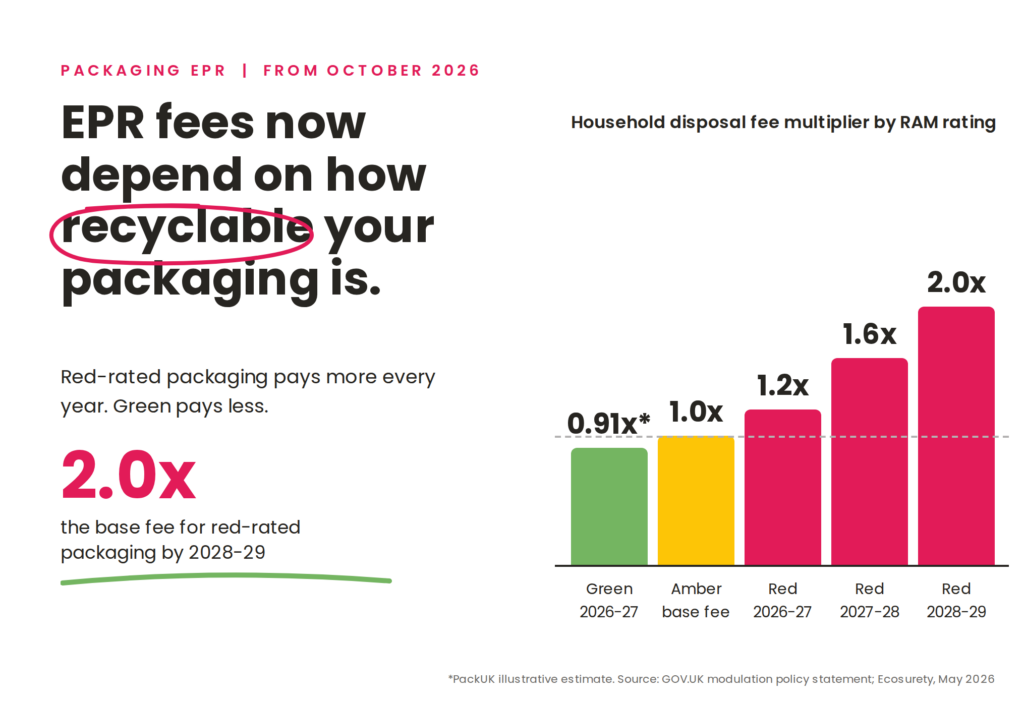
Fees are now adjusted by recyclability rating:
- Green (e.g. standard corrugated cardboard) — fee discount
- Amber — unchanged
- Red (e.g. stretch film, flexible packaging) — 29% surcharge
Key deadlines
Large producers report on 1 April and 1 October each year. October 2026 is the next one — now is the time to get your data ready.
3. EU Packaging & Packaging Waste Regulation (PPWR)
PPWR applies to any business placing packaged goods on the EU market — directly, or through a distributor.
It’s rolling out in stages:
August 2026 Declarations of conformity required, confirming your packaging is:
- Free of heavy metals above threshold
- Free of PFAS
- Food-contact compliant, where relevant
- Generally chemically safe
2028 Harmonised labelling required across all packaging placed on the EU market.
2030 Every piece of packaging gets a recyclability grade, A–F. Anything below a C can’t be sold in the EU. Multi-material packaging (e.g. a box with foam inserts and multiple liners) tends to score lower, since it’s harder to separate for recycling.
Ongoing EPR registration is required separately in every EU member state you supply into. Wide EU distribution can mean a lot of national registrations to manage.
August 2026 sounds distant. For anyone who hasn’t started preparing, it isn’t.
Where Actionpoint Can Help
PPT — Nearly all our plastic meets or exceeds 30% recycled content, which typically removes your PPT liability. We can also supply up to 50% recycled shrink film where no compliant option existed before. Ask your account manager for a PPT-inclusive comparison quote.
EPR — We hold accurate weights, material classifications, and RAM ratings for everything we supply — ready to download in the format your compliance scheme needs. If your packaging is red-rated, we can help you look at greener alternatives.
PPWR — We can provide conformity documents and structured packaging data by SKU in export-ready formats, cutting down the admin of multi-country EU EPR registration.
Need Help Working Out Where You Stand?
Talk to your Actionpoint account manager. We’ll review your packaging, identify where you have obligations, and make sure you’ve got the right data for every submission.
0800 840 9570 | [email protected] | actionpoint.co.uk
This summary is provided for guidance only. Regulations continue to evolve — verify deadlines and requirements against current official guidance before taking compliance action.