EPR fees are being invoiced this October. What component manufacturers should check
If your business is a large producer under packaging EPR, this autumn’s invoice works differently from last year’s. For the first time, what you pay depends on how recyclable your packaging is. Here is how to tell whether that affects you, and what to check before your next submission.
What has changed this autumn
Year one fees were a flat rate per tonne. The first invoices went out from October 2025, based on the 2024 tonnages producers reported.
Year two is different. PackUK is issuing invoices directly to producers from October 2026, on top of your PRN obligations. From the 2026-27 scheme year, fees are modulated by how recyclable your packaging is.
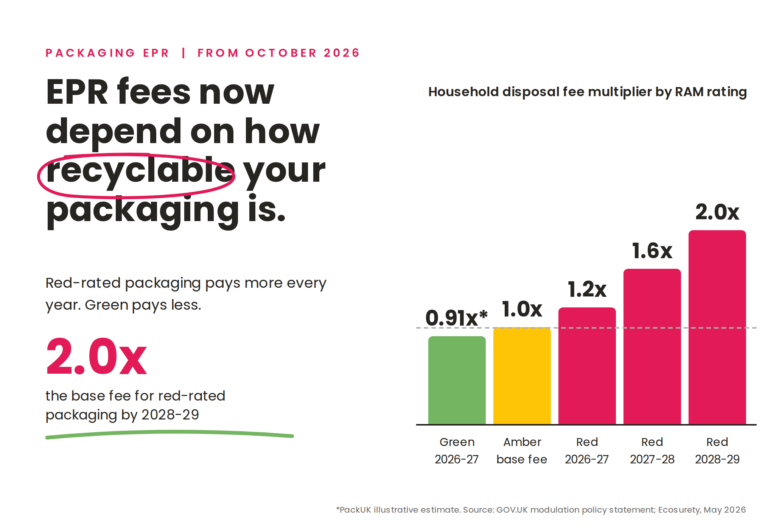
Modulation uses the Recyclability Assessment Methodology (RAM). Every in-scope packaging material is rated red, amber or green, with red the least recyclable. Amber pays the base fee. Red pays 1.2 times the amber fee, and PackUK has estimated the green discount at around 9%, although that figure is uncertain while RAM data is incomplete.
The red multiplier then rises to 1.6 in 2027-28 and 2.0 in 2028-29. Packaging that costs 20% more this year will cost double within two years.
Does it affect your packaging?
This is the question that matters most for component manufacturers, and it depends on where your packaging ends up.
Modulation applies to the household packaging waste disposal fee. Non-household packaging does not pay that fee, although both household and non-household packaging still carry PRN obligations.
The regulators’ guidance is clear on the basics. Secondary and tertiary packaging are non-household. Primary and shipment packaging are household unless they meet specific conditions: supplied to a business or public institution that is the end user, or that passes the goods on with all the packaging removed, or used for a product designed only for business use that is not likely to end up in a household or public bin.
Household is the default, and the burden of proof is on you. Non-household claims need documentary evidence, kept for seven years. Having a commercial waste collection is not enough on its own.
Where component manufacturers get caught out
Most of our customers sell to other businesses, so it is easy to assume everything is non-household. In practice there are four common problem areas:
- Direct sales to OEMs. Usually the cleanest case, but only if the paperwork backs it up. Contracts, sales records, signed customer declarations and product information confirming business-only use all help. One document is often not enough.
- Distributors, trade counters and online sales. If a box can reach someone at home, it is likely to count as household.
- Mixed channels. Where the same packaging goes to both consumers and businesses, it has to be reported as household unless you can prove each supply met the non-household conditions.
- Spares and service kits. Replacement parts sent to installers or end users are easy to overlook, and they often ship in the same box as your main product.
Why the rating matters more each year
Simple formats tend to rate well. Mono-material designs and packs that suit UK recycling infrastructure attract lower fees. Complex multi-layer packs and non-recyclable formats pay more.
In our sectors, the formats worth checking are the ones that combine materials: foam bonded to board, laminated films, windowed cartons and mixed-material inserts. They often protect well, but they may now be costing you more on EPR than they need to, and that cost rises every year.
Material choice matters too. Wood’s amber fee rose from £280 a tonne in 2025 to £450 a tonne in 2026. Pallets are tertiary packaging, so they are non-household, but wooden cases that go to end users are worth a second look.
Five checks before your next submission
- Split your packaging by channel: list which products go direct to businesses, which go through distributors and which can reach consumers. The household share is the part of the bill you can influence.
- Check your evidence: for every line reported as non-household, make sure you hold the documents to prove it. Without evidence, it becomes household packaging.
- Ask for RAM ratings: for anything household, find out whether it rates red, amber or green. Your packaging supplier should be able to help.
- Look for mixed materials: foam glued to board and film laminated to paper are good places to start. A mono-material alternative may give the same protection at a better rating.
- Look at weight: fees are charged per tonne. Board or film heavier than the product needs costs you twice, once when you buy it and again on your EPR invoice.
For the wider picture on EPR, Plastic Packaging Tax and what is coming next, see our guide to UK packaging regulations in 2026.
How can Actionpoint help?
Your EPR bill is set by the packaging you buy, so that is where you can change it. We can go through your current packaging line by line, flag mixed-material formats and heavier-than-needed specs, and suggest alternatives that still protect the product. Where a change will make no difference to your fees, we will tell you.
Get in touch
Know which of your packaging counts as household, and what it is rated. That is the part of your EPR bill you control. Contact us today or call 0800 840 9570 for a second pair of eyes before your next submission.
This article is general guidance, not legal advice. For your own obligations, check the GOV.UK guidance or ask your compliance scheme.